Ages 3–6 · The Children's House
Primary Program
Where Children Begin to Discover Who They Are
Dr. Montessori called this the most critical period of childhood. We treat it that way.

Schedules We Offer
Choose the Schedule That Works for Your Family
We offer flexible scheduling options to suit different family needs. All programs include optional Before Care where noted.
Primary Half Day
8:15 AM – 11:45 AM
$750/month
Primary School Day
8:15 AM – 3:00 PM
$1,000/month
Primary Full Day
7:00 AM – 6:00 PM
$1,310/month
Primary Early Dropoff (optional)
7:00 AM – 8:15 AM
$170/month (if not on Full Day)
Scholarships may be available to help offset tuition costs.

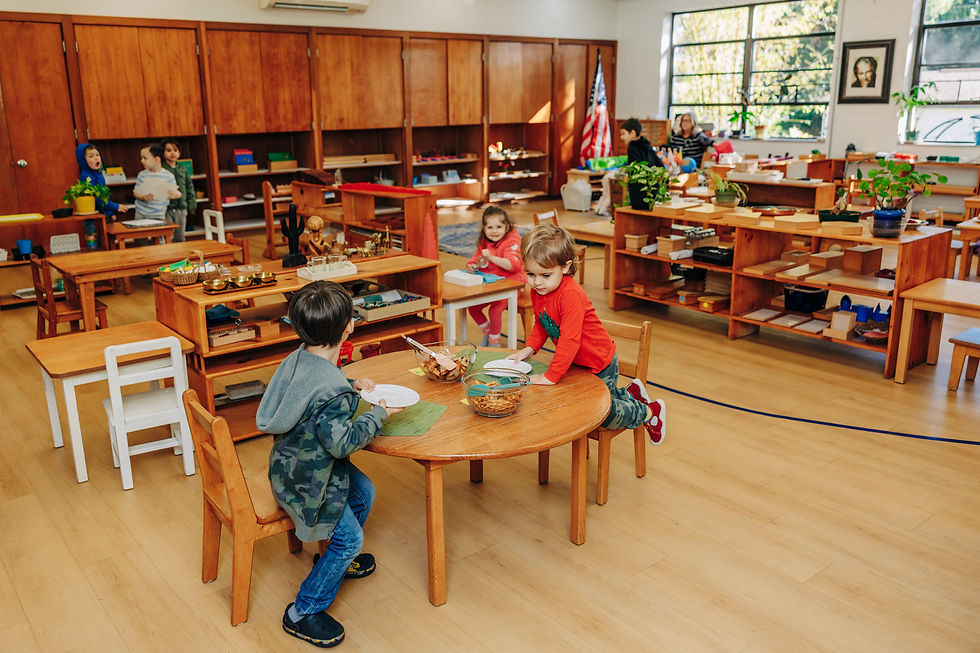
Casa dei Bambini
More Than a Classroom A Place Children Live In
Dr. Montessori called the 3–6 environment the Casa dei Bambini — the Children's House. It is not merely a room with activities. It is a space where children take responsibility for their surroundings, care for themselves, and develop pride in contributing to their community.
The materials here are carefully sequenced from simple to complex, concrete to abstract. Children build understanding step by step — at their own pace, in their own time.
The Curriculum
Writing, Reading, Mathematics, and More — All Through Discovery
In the Children's House, learning is never passive. Here's how some of the key materials work:
Montessori Number Rods
The Number Rods are one of the first math materials introduced in the Montessori Primary classroom for ages 3–6. They build a child’s concrete understanding of quantity and lay the foundation for abstract number concepts. Children can see and feel the difference between “three” and “eight,” for example, because the rods are different lengths. As the child places the rods in order, they count “one, two, three…” developing number sequencing and order.
Montessori Method Language Skills
Toddlers and young Primary children begin with picture-only cards (for example, animals, fruits, or household items). Once children know the objects and vocabulary, labels are added. As reading skills strengthen, the guide introduces cards with words only. The child reads the card, then goes to find the object in the room (“Bring me book”) or acts it out if it’s a verb card (“jump”). This makes reading active and fun, helping the child internalize that words are instructions for meaning and action.

Montessori Puzzle Maps
The world map is designed with precise details; colors are consistent, making the countries easier to memorize; the sizes are proportional; and children are often amazed how small and large countries are compared. In addition, the peg on each country is designed so that the child holds the piece as they would a pencil.

Moveable Alphabet
Children begin to recognize 3-4 consonant sounds (blue) and one vowel sound (red) in a much less intimidating way than with paper and pencil. The goals of this lesson are to focus on order, concentration, coordination, independence, self-esteem, and preparation for writing, reading, and spelling.
FAQs
Everything You Need to Know
What ages are in Primary?
Children ages 3 through 6 share the Primary environment.
Why is consistent attendance so important?
The three-hour uninterrupted work cycle is central to the Montessori Primary experience. Irregular attendance can disrupt a child's concentration and rhythm, so families are encouraged to commit to consistent, on-time arrival.
Does my child need to know how to read before starting?
Absolutely not. The Primary environment develops reading and writing skills from the ground up using the Montessori sequence of materials.