Ages Walking Well – 36 Months
Toddler Program
A Child-Sized World Built for Independence
N.E.S.T. — Nurturing Environment Specialized for Toddlers — is where little ones begin to discover what they can do for themselves.

Schedules We Offer
Choose the Schedule That Works for Your Family
We offer flexible scheduling options to suit different family needs. All programs include optional Before Care where noted.
Toddler Half Day
8:15 AM – 11:45 AM
$840/month
Toddler School Day
8:15 AM – 3:00 PM
$1,200/month
Toddler Full Day
8:15 AM – 5:00 PM
$1,440/month
Toddler Early Dropoff (optional)
7:00 AM – 8:15 AM
$170/month
Scholarships may be available to help offset tuition costs.

The Toddler Years
This Is When It All Begins
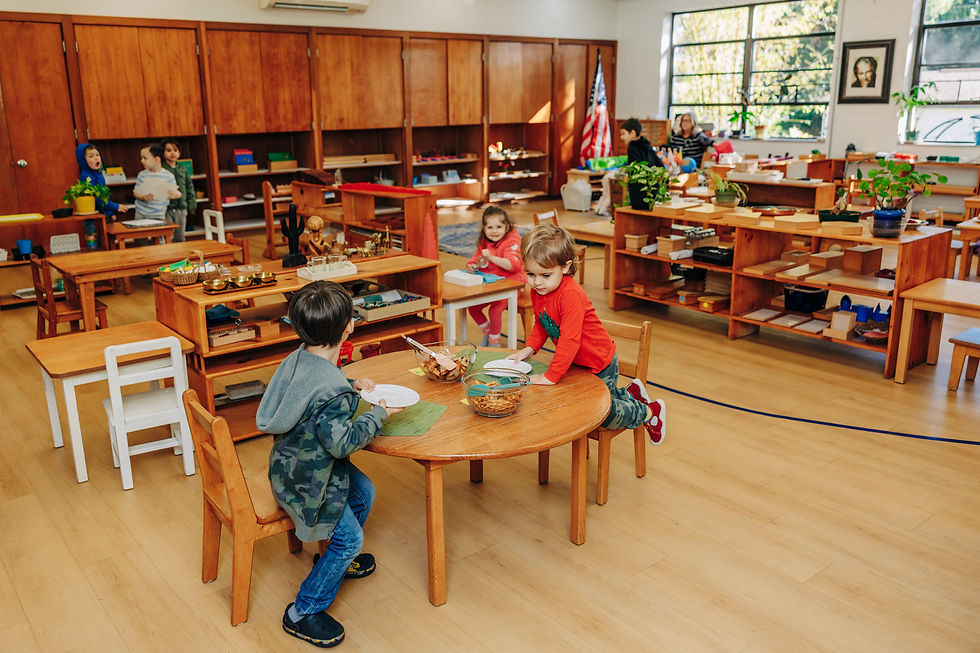
Dr. Montessori understood that toddlers aren't small children — they are a distinct kind of learner, driven by a powerful need to do things themselves. Our Toddler environment is designed entirely around that drive.
Everything here is proportioned to your child. The materials are purposeful. The activities — called "practical life" — are real work that builds real skills: language, movement, concentration, independence, and self-esteem.
A Day in N.E.S.T.
Real Work. Real Learning.
In our Toddler community, children aren't playing pretend — they're doing real things that have real meaning. Here are some examples of what that looks like:

Language Cards
This child is working with identical matching language cards. He is fully concentrating to determine if they are exactly the same. By comparing details to find exact matches, children strengthen visual perception, a foundational skill for letter recognition later on.

Baking
Baking activities allow toddlers to do real work with real tools, which is central to Montessori. Measuring, pouring, mixing, and kneading build fine motor control and hand–eye coordination, while following a sequence of steps helps toddlers develop order, concentration, and confidence in their ability to complete meaningful tasks.

Mortar and Pestle
The grinding motion required when working with a mortar and pestle strengthens the wrist, hand, and arm—building the exact muscles toddlers will later need for writing and self-care tasks (like buttoning or pouring). Using two hands together in a controlled, circular movement refines hand–eye coordination. Toddlers must sustain focus and repetition, which develops their ability to concentrate.

Dressing Frame
This child is working with the zipper dressing frame. Dressing frames allow children to practice fastening skills in a low-pressure setting before applying them to their own clothing. Working with small buttons, zippers, or snaps strengthens the hand muscles and coordination needed for writing later on.
FAQs
Everything You Need to Know
What ages does the Toddler Program serve?
The Toddler Program serves children who are walking well through 36 months (3 years old).
Why is the Toddler Program also called "The NEST"?
N.E.S.T. stands for Nurturing Environment Specialized for Toddlers, and reflects the warm, supportive atmosphere of this community.
When does my child move to Primary?
Children typically transition to the Primary Program between 2½ and 3 years old, when they are developmentally ready. The transition is planned collaboratively between parents and the teaching team.
Do toddlers need to be toilet trained to enroll?
No. Toileting is part of the Toddler curriculum, and children develop independence in this area through their daily practical life activities.