Why Children Thrive in Mixed-Age Classrooms

One of the first things families notice when they visit a Montessori school is that children of different ages learn together in the same classroom.
At first, it can seem surprising. Wouldn't children learn better if everyone were the same age?
In Montessori, we believe just the opposite.
Mixed-age classrooms aren't a compromise—they're one of the greatest strengths of a Montessori education. They reflect the way children naturally learn from one another and create opportunities that simply aren't possible in a traditional, single-grade classroom.
Learning Happens Naturally
Think about how children learn outside of school.
They watch older siblings tie their shoes. They imitate cousins setting the table. They learn games from neighborhood friends. They ask questions, observe, and practice until they can do it themselves.
This is how human beings have always learned.
A Montessori classroom intentionally recreates this natural environment.
Instead of separating children by birthdays, we bring together children who are at different stages of development so they can learn with—and from—one another every day.
Younger Children Are Inspired
Anyone who has spent time around young children knows they love watching older kids.
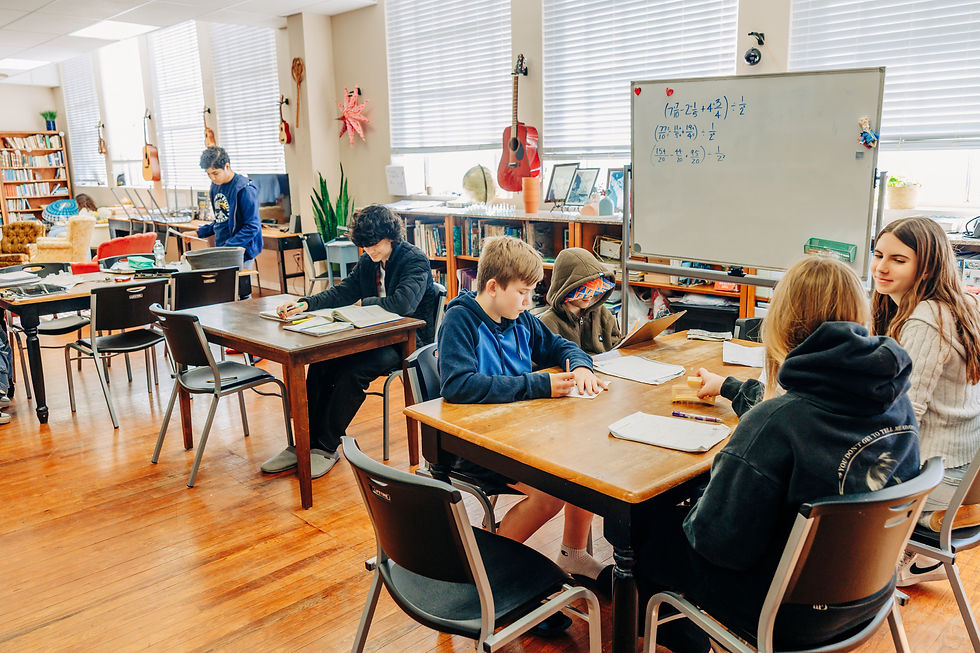
In a Montessori classroom, younger students see what's possible. They watch older classmates read, solve math problems, care for the classroom, and confidently use materials they haven't yet mastered.
Rather than feeling intimidated, they're inspired.
They begin to think, "One day, I'll be able to do that too."
This creates motivation that comes from genuine curiosity rather than competition or external rewards.
Older Children Become Leaders
One of the best ways to truly understand something is to teach it.
As children grow, they naturally transition into leadership roles within the classroom. They answer questions, demonstrate lessons, welcome new classmates, and model kindness and responsibility.
Teaching and mentoring deepen their own understanding while building confidence, patience, empathy, and communication skills.
Leadership isn't assigned—it develops naturally through daily experience.
Every Child Gets to Be Both Learner and Leader
In a traditional classroom, students are often the youngest one year and suddenly the oldest the next.
In Montessori, children experience a gradual progression.
During their first year, they observe.
During their second year, they gain confidence.
By their third year, they're often mentoring younger classmates and helping shape the classroom community.
Every child experiences what it feels like to learn from others—and what it feels like to help others learn.
Those experiences build humility, confidence, and a genuine sense of belonging.
Learning Happens at the Right Pace
Children don't all master new skills on the same timeline.
Some are ready to read at four. Others at six.
Some become fascinated with multiplication long before their peers. Others need more time to build foundational skills.
A mixed-age classroom makes room for these differences.
Rather than feeling rushed to keep up—or held back while waiting for others—children receive lessons when they're developmentally ready.
The focus shifts from "What grade are you in?" to "What are you ready to learn next?"
That simple change reduces unnecessary comparison and allows children to develop confidence in their own abilities.
A Stronger Community
Perhaps the greatest benefit of a mixed-age classroom isn't academic at all.
It's the sense of community.
Children learn to celebrate one another's successes instead of competing against each other. They develop friendships across ages. They practice patience, cooperation, compassion, and respect every day.
The classroom begins to feel less like a collection of students and more like a family.
Everyone has something to contribute, and everyone has someone to learn from.
Preparing Children for Real Life
Outside of school, we rarely spend our lives surrounded only by people our exact age.
Families, workplaces, neighborhoods, and communities bring together people with different experiences, strengths, and perspectives.
Mixed-age Montessori classrooms help children develop the social and emotional skills they'll use throughout their lives: collaboration, leadership, communication, empathy, and confidence.
These aren't lessons taught in a textbook—they're learned through daily interactions with people of different ages.
More Than a Classroom Structure
Mixed-age classrooms are one of the defining characteristics of authentic Montessori education because they support the whole child.
They create an environment where children feel challenged without being pressured, supported without being limited, and valued for who they are—not simply for how they compare to others.
At Mount Dora Montessori, our mixed-age communities help children grow into confident, capable learners who are just as comfortable asking for help as they are offering it.
Because education isn't just about learning alongside children your own age—it's about learning how to thrive in a community.

Comments